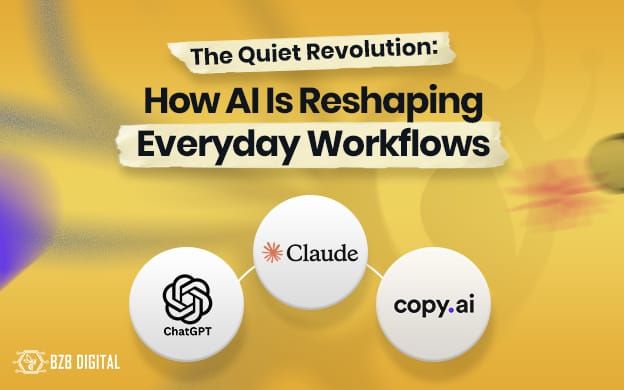
The Quiet Revolution: How AI Is Reshaping Everyday Workflows
A silent revolution is reshaping the way we work and chances are, you’re living in the middle of it without even realizing just how far it’s come. From marketing agencies and small businesses to solopreneurs and freelancers, artificial intelligence (AI) has quickly become more than just a helpful assistant. It’s becoming an invisible team member fast, tireless, scalable, and surprisingly creative.
AI tools like ChatGPT, Claude, Copy.ai, Jasper, and MidJourney are no longer nice-to-haves. They’re essentials. They don’t just support your tasks they’re quietly transforming how we think, plan, create, and execute in nearly every industry.
1. ✍️ The Rise of AI-Powered Content Creation
Creating impactful content used to take hours sometimes days. Writers would agonize over headlines, social posts, intros, and formatting. Now, thanks to AI, that process is faster, more collaborative, and more strategic.
Imagine this: A social media manager at a boutique agency once spent half their day drafting captions, writing blog intros, and brainstorming subject lines. With tools like ChatGPT or Copy.ai, they now generate platform-specific drafts in under an hour, freeing up time for strategy, design collaboration, and community engagement.
Real-life example:
Mia, a freelance content creator, increased her monthly output by 4x after integrating AI. She now generates polished first drafts with ChatGPT, adds her personal tone, and schedules content across platforms—all in one afternoon.
The result? Better content, faster delivery, and way less burnout.
2. 🎯 Smarter Audience Targeting with AI
Forget broad marketing messages that try to please everyone. AI now empowers brands to understand their ideal audience on a deeper, more emotional level what they care about, when they’re most engaged, and even how they prefer content to be phrased.
Platforms like Persado, Jasper, and even social ad managers use machine learning to analyze user behavior and offer language patterns, tone, and visual styles that convert better.
Real-life example:
DigiScope, a boutique digital agency, used AI-driven insights to analyze audience behavior and engagement. After adapting their messaging to match what the data revealed, they saw a 42% increase in email open rates and a 30% jump in conversions all in just three months.
Data-driven creativity is the new secret weapon.
3. 💡 From Creative Blocks to Instant Inspiration
The blinking cursor. The blank page. The deadline creeping closer. We’ve all been there.
AI doesn’t replace creativity it amplifies it. Think of it as a brainstorming partner that works 24/7, throws out dozens of ideas on demand, and never gets stuck.
Need a headline, slogan, blog title, or ad hook? With tools like Claude or ChatGPT, you can generate multiple versions in seconds. Then, with human judgment, refine and repurpose the ideas.
Real-life example:
Kevin, a YouTube scriptwriter, uses ChatGPT to create outlines and segment ideas. What used to take 3+ hours now takes just 30 minutes leaving him more time to inject humor, personality, and emotion into his final content.
AI unlocks creativity by removing the friction of starting.
🔗 Start your journey into the world of autonomous AI:
4. 📊 Data Interpretation Made Easy
Data is only powerful when it’s understood and AI is making that easier than ever.
Gone are the days of getting lost in dashboards or exporting endless spreadsheets. With tools like Power BI (with AI plugins), Beautiful.ai, and Google Looker Studio, you can ask questions like, “Which campaign drove the most engagement in Q2?” and get clear, visual insights within seconds.
Real-life example:
A small eCommerce store used AI analytics to discover that their late-night shoppers had a 30% higher purchase rate. They shifted ad budgets to run after 9 PM and saw a 19% revenue increase in just six weeks.
AI helps translate numbers into action so decisions aren’t just faster, they’re smarter.
5. Time-Saving Automation That Scales
SAI doesn’t just help you think better it helps you work faster. Tasks that used to take hours now take minutes or are completely automated.
From scheduling social posts to answering FAQs, generating invoices, or even editing short-form video, AI handles the repetitive work. You stay focused on the high-value tasks that move the needle.
Real-life example:
Sarah, a solopreneur managing a Shopify store, uses AI to run customer support chats, generate weekly newsletters, and optimize her product descriptions. Her operational workload dropped by 60%, giving her more time to innovate and expand her product line.
Automation is no longer a luxury it’s a survival tool.
🎥 Want to See AI in Action?
📺 Watch this in-depth demo showing how AI tools are transforming real workflows across writing, marketing, design, and analytics:
🔚 Final Thoughts: The Future of Work Is Already Here
This isn’t just a tech trend it’s a fundamental transformation of how we create, connect, and work. AI has quietly integrated itself into every workflow, helping us move faster, think smarter, and do more with less.
From content creation and marketing to analytics and automation, the impact is clear: those who embrace AI now are already outperforming, outproducing, and outmaneuvering their competition.
It’s not about replacing humans it’s about elevating them. The question is no longer if AI fits into your workflow, but how quickly you’re willing to adapt and make it your ally
✅ TL;DR: Why AI Matters to Your Work
- Boost productivity: Get more done in less time
- Enhance creativity: Brainstorm better, write faster, break through blocks
- Make data useful: Turn metrics into meaningful insights
- Automate the boring stuff: Free up your time for strategic work
- Improve targeting: Write and design with precision for your ideal audience
- Scale smarter: Whether you’re a freelancer or a team, AI multiplies your capacity
💬 FAQ: AI & Everyday Workflows
Not exactly. AI won’t replace people but it will replace the way tasks are done. Those who adapt will thrive. Those who resist risk falling behind.
Not at all. Most AI tools are designed for non-technical users. If you can use Google Docs, you can use AI platforms like ChatGPT or Jasper.
Start small. Try using ChatGPT for emails or Copy.ai for social captions. Test what works, then build out from there.
Yes AI is a starting point, not the final word. Always review, fact-check, and personalize the content. Think of AI as your creative collaborator, not your replacement.